Pitot-static instruments & blockage
Speed, altitude, and rate-of-climb instruments all run off air pressure, from two sources. The airspeed indicator (ASI) uses both pitot (ram air) and static; the altimeter and vertical speed indicator (VSI) use static only (POH/AFM).
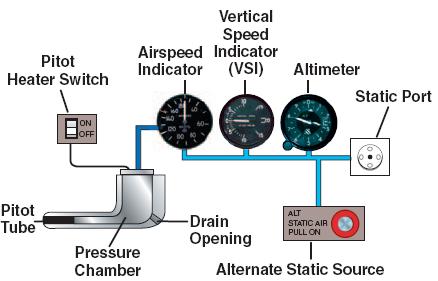
The idea: each instrument shows the difference between a pressure sealed in its case and the changing outside pressure. To work out a blockage, ask which side is stuck and which can still move.
Blockages (memorize the four):
| Blockage | Effect |
|---|---|
| Pitot inlet blocked, drain open | Ram pressure leaks out: ASI reads zero |
| Pitot fully blocked (inlet + drain) | Pressure sealed: ASI acts like an altimeter, reads high in a climb, low in a descent |
| Static port blocked (pitot clear) | Altimeter freezes at that altitude; VSI stuck at zero; ASI correct there but under-reads climbing, over-reads descending |
| Alternate static (unpressurized cabin) | Cabin static is a bit low: altimeter and ASI read slightly high, VSI shows a momentary climb |
A fully-blocked pitot ASI reads high in a climb because the static falls but the trapped pitot pressure can't, so the gap (the "airspeed") looks bigger. A blocked-static ASI reads low in a climb because now the static is trapped high while the real static falls, shrinking the gap.
Trap: don't confuse the two pitot cases. Drain open bleeds off to zero; drain also blocked traps the pressure and mimics an altimeter. And a blocked static moves the ASI the opposite way from a blocked pitot in the same climb (POH/AFM).
Note: the pressure altimeter itself is TC AIM AIR 1.5; the pitot-static source split and the blockage behaviours here are standard instrument theory / aircraft-specific plumbing (POH/AFM), not spelled out in the TC AIM or TP 1102.
References
- TC AIM AIR 1.5
- POH/AFM